Showing posts with label Ulaanbaatar. Show all posts

Thursday, March 29, 2012

Nomadic Herders: finish on a cliche, with a twist.

Today is my penultimate day at Mercy Corps Mongolia. It seems quite fitting to finish off by writing a story about a Mongolian herder - the most cliche of Mongolian experiences. The family was gorgeous. The little girl one of the cutest ever, and that is saying something in a land of insanely cute kids. The location was stunning. In Gobi-Altai province - Gobi means desert and Altai means mountains - this place was named very literally. The drive to this herder is something I want to forget. It was dark (before sunrise) and bumpy and I don't think the driver found any kind of road for a lot of it.

But the drive back. Weeeew!

The sun was just getting over the mountains, and we were hit with amazing light shining off the gobi-esque sand dunes, with towering, snow covered mountains in the distance. It was the most amazing "this is truly stunningly beautiful" moment I have had here, and there have been many.

And despite the nomadic herder being a Mongolian cliche, it really isn't a cliche at all. It is a fantastically amazing feat that these guys live like they do, and love it.

The Scenery


The Story

Smarter Herding: Sheep Coats
Bayraa, Gobi Altai Province


Bayraa is a 35 year old husband, father of three and ‘champion’ herder in his home province, Gobi Altai.

He was awarded the ‘champion’ herder title in recognition of his community minded response the natural disaster, called dzud, that hit his region and decimated a quarter of all livestock across Mongolia. Dzud is a combination of dry summer, meaning fodder doesn’t grow; followed by severe winter, brining cold temperatures, icy winds and large amounts of snow resulting in widespread death of livestock due to starvation.

A combination of preparation and luck meant that Bayraa’s herd only suffered minimal impact. Watching herders around him lose their animals – their source of food, and income; with no way to start again he came up with a scheme to give them some of his livestock in return for labour.

Today we are visiting Bayraa and his family to see a new ‘sheep coat’ in action. Bayraa volunteered to trial a Mercy Corps initiative of coating sheep and goats in winter. The idea is based on standard practice in Australia, the largest producer of sheep meat in the world, where sheep are covered in specifically designed plastic covers to protect their wool from damage and keep them warm in cold weather. Of course, conditions in Mongolia are significantly colder with winter temperatures plummeting below negative thirty degrees Celsius, and staying there for almost half the year.

Traditionally Mongolian herders move their herds to pasture daily, bringing them into basic wooden shelters at night, with no additional coverings during winter. Simply covering animals in blankets is fraught with danger: if the animal sweats they will freeze to death. The material being used in the new coats is a breathable plastic, whisking away sweat while generating heat to keep the animal warm. Changing traditional ways is hard, but Bayraa is one of a new generation of herders willing to try new things.

“Traditionally herders do not cover their animals. But also traditionally herders get less income when their products are poor quality from a hard winter, or traditionally we would lose all our animals in dzud. Sometimes traditions need to change.”

Nearing the end of our two hour journey to Bayraa’s home we spot a wolf darting past in the distance. My Mongolian colleagues chatter excitedly. Seeing a wolf like that means we are very lucky.

We arrive at Bayraa’s ger, the traditional round tent-like nomadic dwelling of Mongolians, as the sun is starting to rise. There is smoke coming from the ger chimney, so we know the family – or at least mum – is awake. With no mobile phone reception and no coincidental visit by Bayraa to the provincial town we had no way of warning the family we would be visiting. For these reasons Mercy Corps visits are usually an expected surprise, but a party including a UB officer and a foreign person with lots of questions was surely not expected.

Inside the ger Bayraa and his wife Urantuya are barely out of bed. Their almost one year old daughter is still fast asleep, gently snoring from the single mattress on the floor that the family shares each night.

[our sweet driver was instant friends with the little cutey, once she woke up]

As Urantuya is preparing salty milk tea on the single stove over the ger’s fire the milk boils over. The same kind of excited chatter I heard at the earlier wolf sighting springs up again. Another lucky sign – milk boiling over symbolizes an abundance of blessings for the people inside the ger, I am told.

With so much luck around I am not surprised at Bayraa’s success. As he talks about his achievements he is humble, yet clearly proud. His true joy is in training race horses. As a boy he learnt from his father and grandfather, and now his own son is eager to learn from him. What stands out is his attention to the comfort of his animals. In addition to the usual daily feeding from pasture, he prepares special fodder for his animals with different ingredients to suit the seasons.

This is one of the reasons his animals survived the dzud. Bayraa has the foresight to prepare fodder in autumn to safeguard against a hard winter. Even in a relatively good winter, icy winds and scarce fodder greatly reduce the quality of sheep and goats’ coats. The level of stress an animal experiences is directly reflected in the quality of their wool, so when Mongolian animals stand outside all day in icy winds, their coats suffer and they need more fodder to produce the energy to stay alive. In the long term this means herders get less money for their raw materials.

If livestock can be protected from winds they will both eat less and produce better quality wool, as well as having a better quality of life.

After fitting the new coats to his livestock it was only a matter of hours before neighboring herders rode over on their horses to find out what was going on.

[family with a coated sheep]

“All herders watch each other with binoculars. After I put the coats on my sheep and goats my neighbors were really worried about what I had done to my animals. To them it was a really strange idea.”

“For the first three days the goats without coats were scared of the goats with coats - they were very curious about the coats and tried to remove them with their horns. Now, though, they are used to it and don’t cause any trouble.”

[family outside their ger]

Three months into the trial herders have noticed their coated animals are returning home ahead of the flock, long before its dark. This is a sign that they need less food - one of the key benefits of the coats. When spring comes herders will be able to assess whether the coats have bought a tangible improvement to their animals’ wool.

“I am not sure what will happen. I hope the coated animals weigh more and have better quality coats then the normal animals and that their bodies are stronger and healthier. We will see what happens. But even if there is no difference I am proud to try new ways of helping my animals and earning more income.”

[their home - the ger on the left]

Sunday, March 18, 2012

Amarbayasgalant Monastery and Darkhan City

A month since my last post? I must have been busy. Or lazy. Or a combination of both, together with terrible internet at home...that's what you get for living in a developing country!

A few weekends ago some friends and I decided to take a road trip north, with our awesome Mongolian buddy and his car, to the city of Darkhan. Mongolia's second city - the capital has a population of 1.8 million-ish, Darkhan has a population of around 75,000, so they aren't really in the same category...

The main reason to visit Darkhan was to visit what I had heard was a beautiful monastery "closeby". Being in Mongolia, closeby turned out to mean a 90 minute drive, half of it on dirt road.

But the site didn't disappoint. A stunning day, a stunning location and a pretty cool monastery made for a great site to visit in Mongolia.

The trip was organised in very Mongolian style. There had been some casual suggestions of taking a road trip at some point in time, and an awareness that a few of us were in town while most of the volunteers were heading further north for a week-long trip. Our Mongolian buddy called on Friday night, about 9pm, and said let's go at 9am on Saturday morning. Great! The car could fit 4. With our fantastic communication skills 6 people were lined up to come. With the benefit of hindsight it was great that one bailed and 5 of us managed to squeeze into a 4 seater car.

Since we were heading north, and traveling between two cities, we actually had paved roads to travel on! An amazing novelty in Mongolia, we traveled about 4.5 hours on paved roads to reach Darkhan and explored for the afternoon.

On the way into town we passed these massive statue of a man, a PR stunt by the local industrial factory!


We found a huge park, with different features for each of the horoscope signs. A bit dilapidated, it was hard to tell if it was just because it was winter, or if the place really hadn't been used for twenty years.


A feature of children's playgrounds seem to be super-steep slippery dips, dangerously steep slippery dips:

The town was very pleasant: no traffic, no pollution, no rude people. We had dinner at the local hangout - it was relatively gourmet - everything tasted good, and the service wasn't terrible. We were blown away.

The traffic lights even had these counters to show how long until the lights would change!!

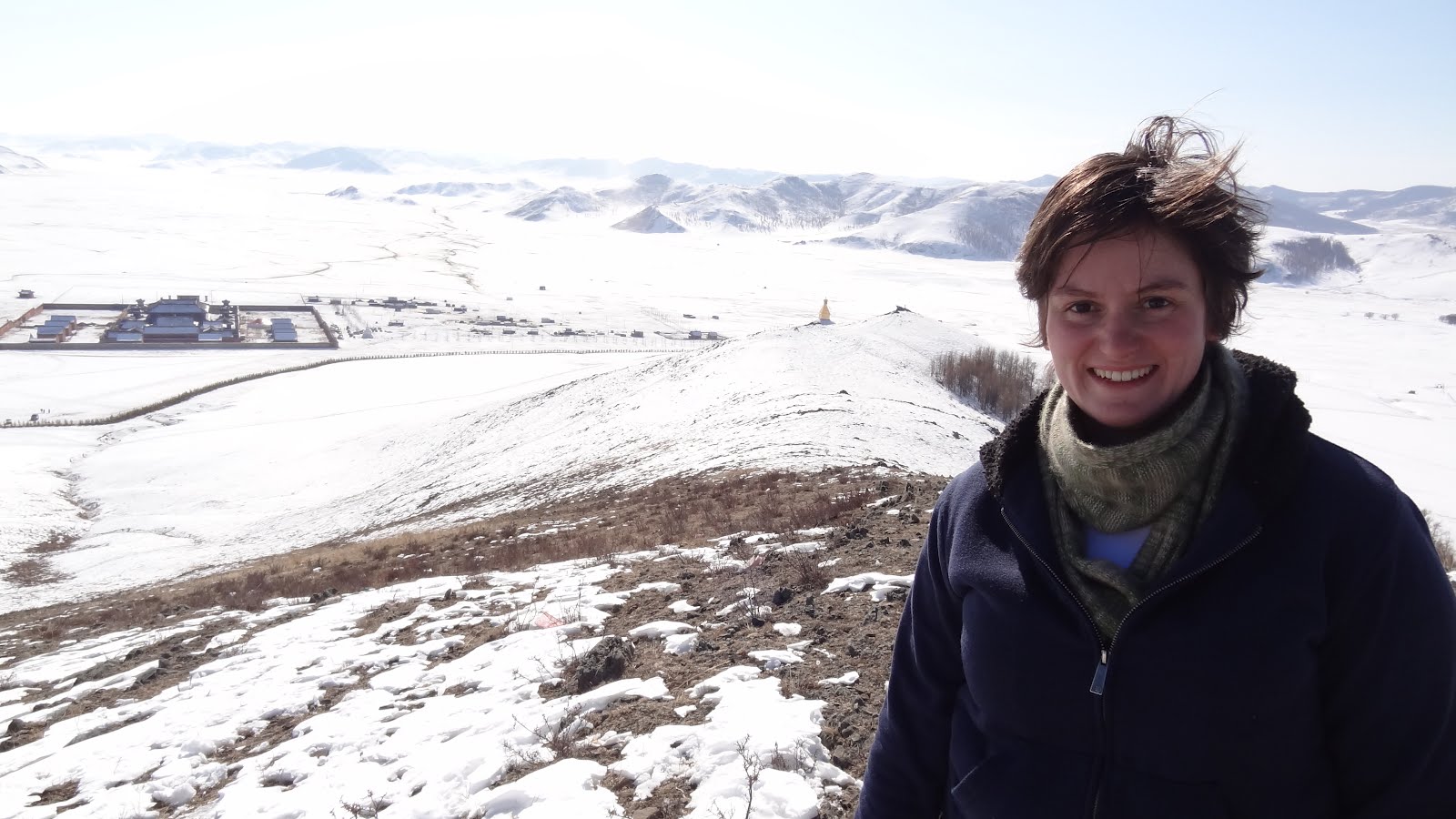
The next day we set out for the famed monastery, not really knowing where to go. We were blessed with a gorgeous day, sun shining and probably around -10 to -5. I actually shed the winter coat for a while, for the first time since October!


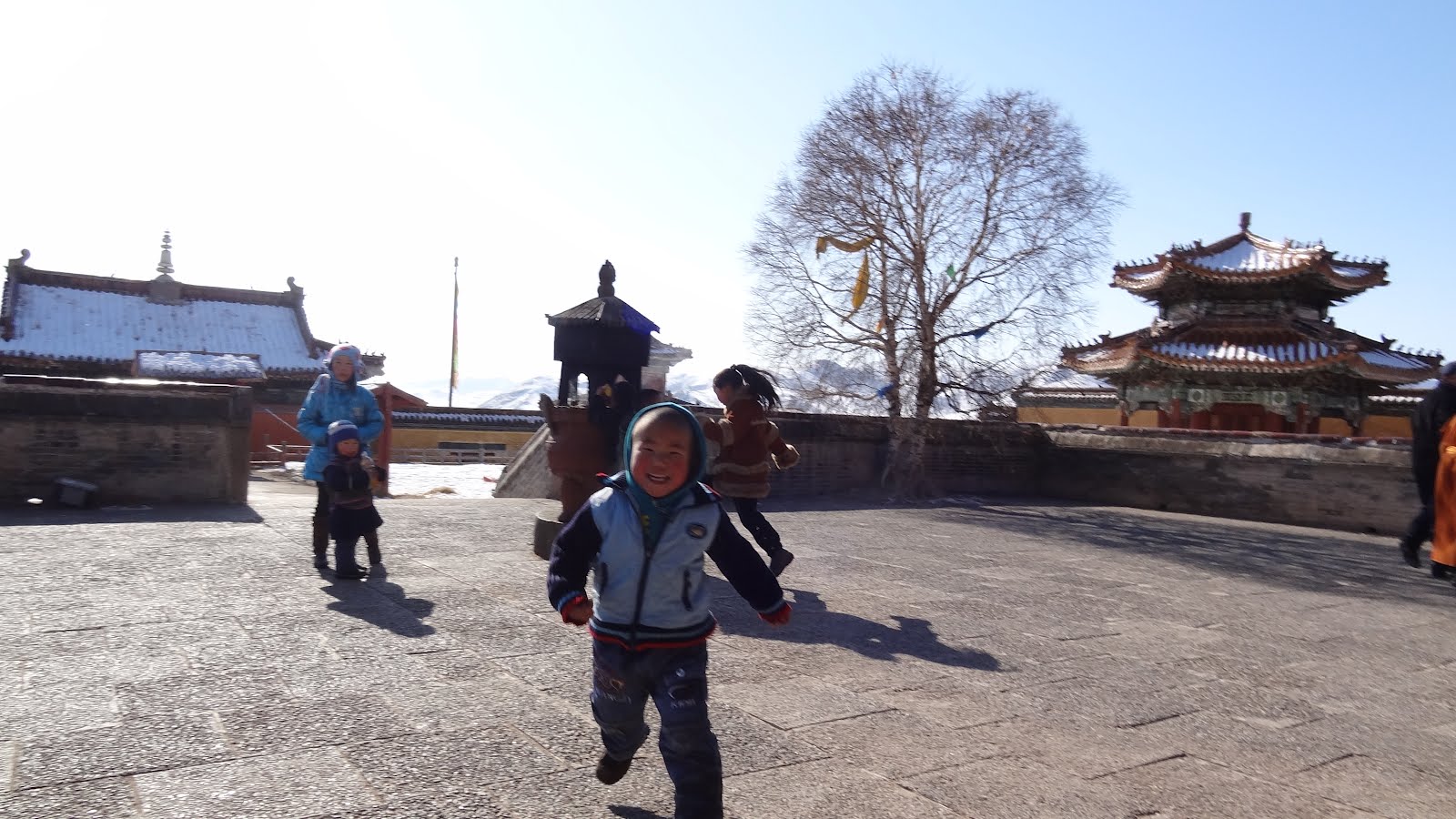
In the main forecourt of the monastery there was a line up to undergo some kind of "re-birthing" process. The person climbs into this stone structure that is clearly not big enough for a person, struggles to stand inside, turn around three times and then emerge - reborn!


Who cares about a monastery?


The special thing about the monastery, other than it's beautiful location, is that it is one of the oldest architectural pieces still existing in Mongolia. Being a nomadic society there were always few buildings...most were monasteries built after Buddhism took off a while ago. But when the Soviets came they were less then enthusiastic about religion in any kind, and with little regard for history they not only tore down almost every monastery in the country but systematically purged an estimated 35,000 monks. This has left only a handful of buildings pre-1930 in the whole country - none still completely in-tact. Somehow this monastery managed to keep a few buildings through the destruction...no one knows how, it's got nothing on its former glory though.


There are three other key sites - one in UB, one in the Gobi, and one at the ancient capital, Kharkhorum, each of which I have managed to visit.

The monastery is also special as it was built to honor Mongolia's most famous artist, Zanabazar.

Slightly more academic writing on the subject: http://en.wikipedia.org/wiki/Amarbayasgalant_Monastery

The Highlight?

Despite the pollution-free, friendly city of Darkhan and the gorgeous monastery, the highlight of the trip was undoubtedly the dj skills of our Mongolian buddy..introducing us to fantastic western-artists most of us had never heard of. For example:


Thursday, October 27, 2011

Ulaanbaatar in Autumn

The month since I have returned to Mongolia from a brief visit back home has seen the landscape rapidly, but gradually, change from spring to autumn and now with some strong hints that a typically cold winter is on the way. As one expects in Autumn, the leaves turned - the range of colours in the leaves has been stunning - especially considering the few trees there are in this barren country.

The grass on the vast, endless hills and mountains began showing small sprouts of brown amidst the lush green. This has dulled to an almost uniform brown now. The weather has been kind - daily highs of 10 degrees, and some even higher, is very generous for this time of year. The kind of zero-ish temperatures we should be expecting hit last week. The nights are very cold -15, and the days are chilly at around zero, maybe reaching 5 degrees for what seems like 5 minutes!

It's also a time of change in other areas. A new group of AYADs arrived this week. It seems like only a few weeks ago the last "New AYADs" arrive - but it was three months ago. Now my intake are well and truly the old guys - which means the time for goodbyes is imminent. Very imminent in fact. Our group of six is saying it's first goodbye to one of our own on Saturday week. Living in a place like UB means there are frequent hellos and goodbyes - or housewarming and farewell events - which gets pretty disheartening, and it's even worse when it's your housemate that's leaving.

On the positive side we've got a new AYAD replacing the leaving AYAD in our apartment. And before we say goodbye a group of 4 of us are heading out, including our departing AYAD, to Bayan-Ulgii for a week - this is the Kazakh region in far-western Mongolia. I went here for work and loved it so much I wanted to go back as a tourist. We are going to see kazakh eagle-hunters, hear traditional throat singing, see ancient petroglyphs visit the highest peak in Mongolia and walk up to a glacier - which means we are more than likely going to freeze, spend most of the week without showering, being offered lots of salty milk tea and mutton. Good times!

This week I spent a few hours driving through suburban parts of town I had never been to before - in search of newly built ramps and universal access features (access for all people including those with a disability) such as a paths and curb ramps. We didn't find much, there are only a handful of usable ramps around - a little while ago Mercy Corps had a project that successfully had standards for universal access passed into national legislation. Now the project has been renewed for a phase 2 that will see promotion of the standards to actually be put into practice in new buildings and added to existing civic buildings.

Here are a few pictures from driving around town. It's such a cool place...snow covered mountains in the background, with modern buildings, buddhist temples and gers all mixed in. Hummers drive alongside ancient Russian trucks. Stores for designer clothes are next to stores for coal and wood to burn in gers (yurts).

Possibly the best part of winter is the star suits that babies/toddlers are dressed in.


The C is the equivalent of an L in Australia. My boss at work recently took a leave of absence. She told me that a month of this was spent learning to drive. In soviet times, when she was young, very few people had cars so learning to drive was totally unheard of. Now plenty of people drive without a license or get illegal licenses - but some people are honest. The honest ones, like my boss, spend a month in a car with 3 other learners. They spend the whole day taking turns at driving the group, along with an instructor.


Soviet-style apartments. These guys look identical for blocks on end. No idea how people know which one is there's!

Wood and coal for sale for the fires that keep gers warm.